
This page was translated automatically and may not be perfect.
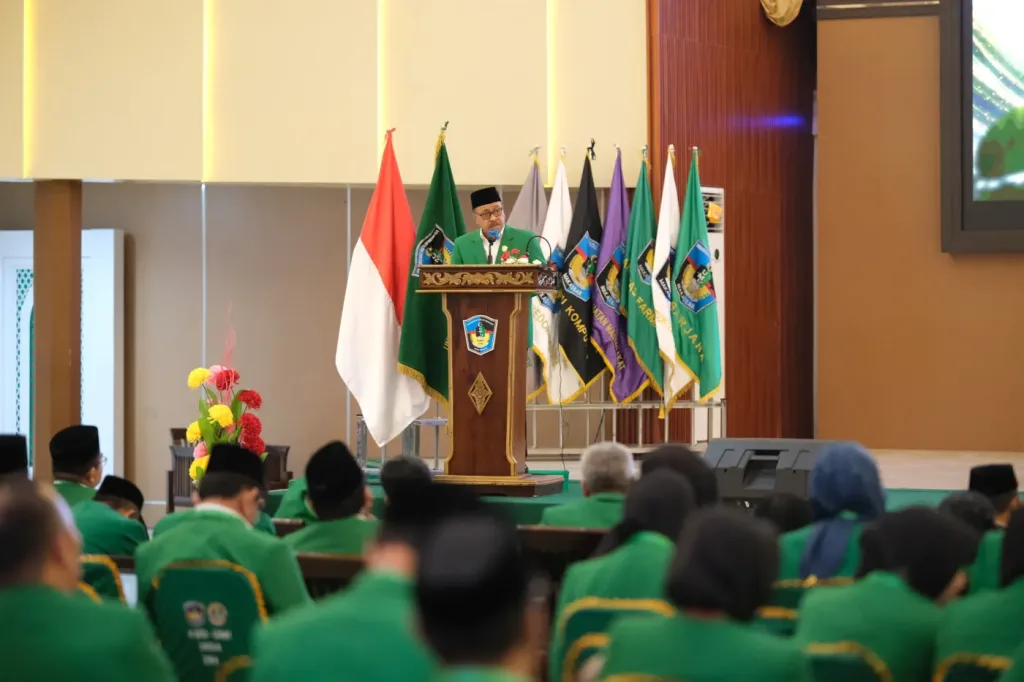
MAKASSAR — Simple, fast service and relying on an integrated system is one of the main messages of the Chancellor of the Indonesian Muslim University (UMI), Prof. Dr. H. Hambali Talib, S.H., M.H., when opening the 2026 UMI Executive Strategic Summit (UMI ESS) at the UMI Al Jibra Auditorium, Saturday (1/8). In front of 177 university leaders, he asked that UMI Connection be used as a new direction for campus development as well as a guide in planning, decision making, program implementation and services.
Forum participants consisted of Vice Chancellors, Postgraduate Program Directors, deans, deputy deans, heads of institutions, hospital directors, Islamic boarding school directors, bureau heads, heads of UPTs, and heads of study programs. The Chancellor emphasized that ESS is not just a new name for the annual work meeting, but an opportunity to change the way the university thinks, works, decides and serves.
"This is no longer just a digital system, not just an application, and not just a collection of data. UMI Connection is the way we think, the way we work, the way we make decisions, and the way we serve," said Prof. Hambali.
From To Do List to Solution List
According to the Chancellor, today's campus challenges do not stop at keeping up with technological developments, but also building governance that is integrated, fast, adaptive and has real benefits. He believes that the success of universities is no longer accurately measured by the number of activities or the size of budget absorption, but rather by changes that are truly felt by society. The work program, he said, must be understood as a list of solutions, and activities that do not solve problems need to be bravely evaluated.
He also conveyed reflections on work culture. The budget can be absorbed well, but students still have to move from one table to another to handle one letter. Reports may get thicker, but service won't necessarily get faster. Things like that, according to him, need to be material for joint evaluation to improve work methods, not to find the party to blame.
Four Disciplines UMI Connection
As a guide towards a Smart Islamic AI-Driven University, the Chancellor asked that there be no more programs that run alone, data that differs between units, or policies that do not support each other. He introduced the four disciplines of UMI Connection:
- One Mind: unite vision, direction and perspective in building a university;
- One Data: making valid and integrated data the basis of every policy;
- One Step: building cross-unit collaboration so that programs support each other;
- One Benefit: ensuring programs, budgets, and decisions provide real benefits to students, the community, and the university's reputation.
The Chancellor also provided four directions for preparing work programs: starting from the problem to be resolved, strengthening collaboration across faculties, institutions, hospitals, Islamic boarding schools, bureaus and units, ensuring that each budget produces measurable changes, and making services to students and the community simpler, faster, easier and based on an integrated system. All programs are asked to have the same common thread, namely supporting the University Strategic Plan, strengthening IKU, improving accreditation and ranking, and accelerating digital transformation through UMI Connection.
The role of PDTI
PDTI views this direction as a very concrete guide for campus information technology work. The image of students switching desks for a single letter shows where integrated systems should make an impact: services that can be completed in one flow, with the same data in each unit.
For PDTI, the One Data discipline means ensuring that systems within the UMI environment are connected to each other and refer to valid data sources. PDTI is ready to support faculties and work units in translating their work programs into more concise digital services, in line with the direction of UMI Connection.
Excerpted from: umi.ac.id