
This page was translated automatically and may not be perfect.
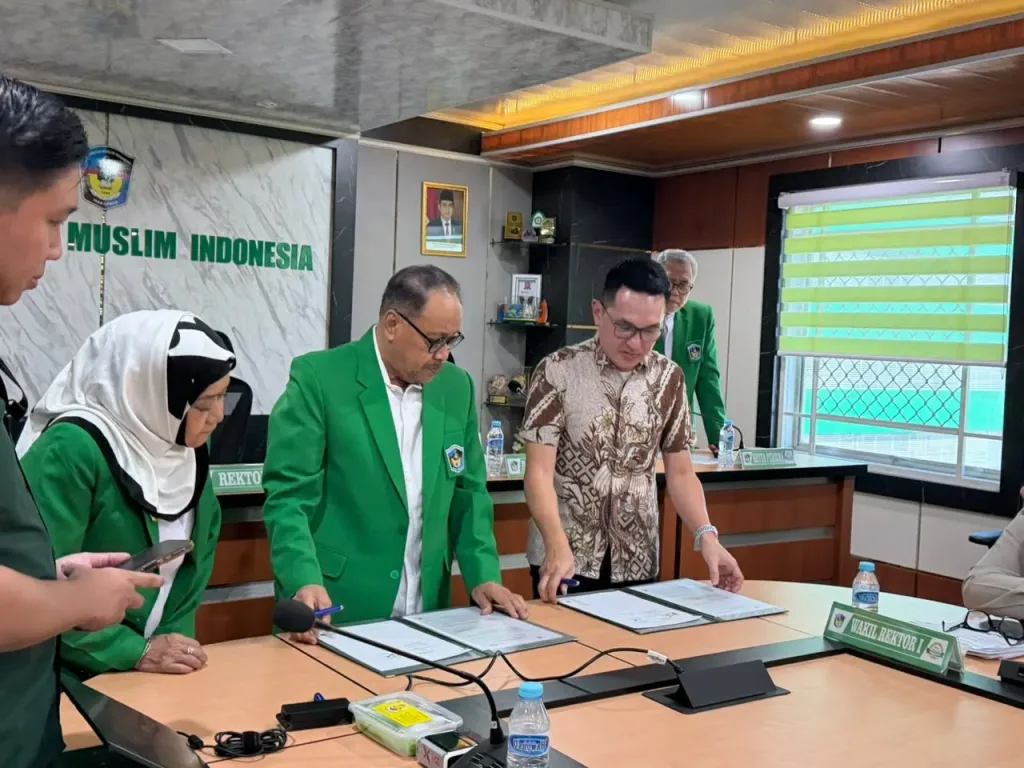
MAKASSAR — The digital transformation of the Indonesian Muslim University (UMI) through UMI Connection is entering a new phase. If in the initial stages the focus was on unifying data, services and work processes within campus, now this connection is directed outwards: connecting UMI with networks of knowledge, research and collaboration that transcend geographical boundaries.
This idea is outlined in the first article in the UMI Connection series entitled UMI's Civilization Entrustment. In it, UMI formulated a shift from connected universities going to connected knowledge ecosystem.
Two Stages of Connectedness
The first stage, Connected University, describes conditions when data, services and processes are connected to each other, while all units work in one ecosystem. The next stage, Connected Knowledge Ecosystem, brings UMI knowledge to meet world knowledge: research is connected to global networks, students get access to international opportunities, and society gets solutions born from campus.
UMI emphasizes that UMI Connection is not positioned as an application alone, but rather as a transformation architecture that gradually connects people, data, processes, services, knowledge and collaboration. On campus, connectedness strengthens governance; beyond campus, it paves the way for cross-institutional and cross-country collaboration. This direction is part of UMI's steps towards a Smart Islamic Digitally-Empowered University.
Leadership Views
UMI Chancellor, Prof. Dr. H. Hambali Talib, S.H., M.H., emphasized that the university of the future needs to be part of a knowledge ecosystem that is much wider than its physical campus. According to him, the strength of higher education is no longer simply measured by the area of land or number of buildings, but also by the size of the network, the quality of collaboration, the movement of ideas, and the resulting impact.
Deputy Chancellor V for Cooperation and Promotion, Ir. Hj. Setyawati Yani, S.T., M.T., IPM., ASEAN Eng., assessed that the cooperation paradigm needs to change along with digital transformation. The success of collaboration, according to him, is not measured by the number of memorandums of understanding, but by what happens afterwards: new experiences for students, research with lecturers, innovation that reaches industry, increased international mobility, and benefits for society.
"The MoU is the door. Outcomes are the reason the door is opened."
Knots That Want to Be Found
UMI Connection is directed at bringing together various nodes in the university ecosystem, including:
- students with global learning opportunities;
- lecturers with academic and professional networks;
- researchers with research partners;
- alumni with alma maters and collaboration opportunities;
- universities with the government and business world;
- science with real societal problems.
All connections are carried out through UMI's Catur Dharma—Education and Teaching, Research, Community Service, as well as UMI's Commitment and Character Education—while remaining based on UMI's identity as a Campus of Science and Worship.
The role of PDTI
For PDTI, the Connected University stage is the closest work area: ensuring data between systems is integrated, digital services can be accessed reliably, and work processes between units are connected in one ecosystem. Without a solid internal foundation, connecting with partners outside the campus will be difficult.
PDTI views the expansion of UMI Connection towards a global knowledge ecosystem as a challenge and direction of work, including in terms of system interoperability, service availability and data protection. PDTI is ready to support so that the connectivity that UMI aspires to is based on reliable infrastructure and data governance.
Excerpted from: umi.ac.id