
This page was translated automatically and may not be perfect.
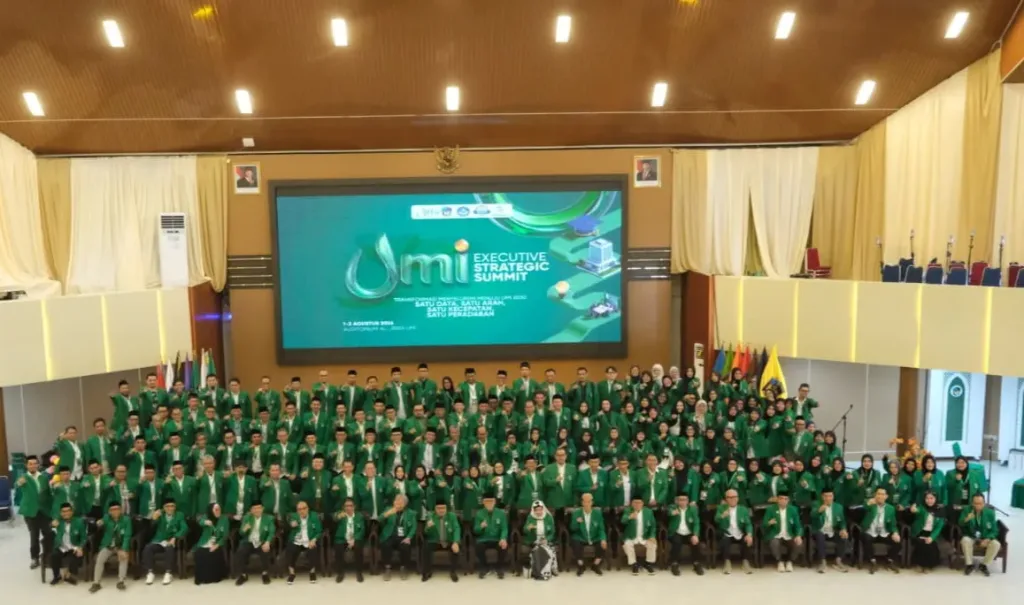
MAKASSAR — The rapid development of artificial intelligence (AI), Internet of Things (IoT), and other digital technologies has encouraged the Indonesian Muslim University (UMI) to make digital transformation one of the main agendas of the 2026 UMI Executive Strategic Summit (UMI ESS). The forum was held at the UMI Al Jibra Auditorium on Saturday (1/8).
UMI ESS 2026 brings together elements of the UMI Waqf Foundation Trustees and Management, rectors, deans, heads of institutions, and work unit leaders. In this forum, UMI emphasized its direction to become an adaptive and innovative higher education institution through three strengths: digital governance, data-based decision making, and cross-sector collaboration.
Disruption Demands New Ways of Working
Head of LLDIKTI Region IX Sultanbatara, Dr. Andi Lukman, M.Si., reminded that higher education is now in the midst of an era of disruption that demands changes in thinking patterns and ways of working.
A similar view was expressed by the CEO of Tribun Network, Dahlan Dahi, who was the keynote speaker. He believes that technological change is no longer something that will come, but is an ongoing reality that affects all sectors, including higher education. According to him, campuses need to build an organizational culture that is fast learning (learning organization), open to innovation, and capable of utilizing digital technology to improve the quality of education, research, services and public communication.
More Than Device Procurement
Responding to this challenge, UMI Chancellor Prof. Dr. H. Hambali Talib, S.H., M.H., emphasized that digital transformation at UMI is not interpreted as shopping for technological devices. What is to be changed is the way of thinking, work culture and university governance.
He explained that digital transformation is an important part of implementing UMI Connection, which promotes university management based on four principles: One Data, One Direction, One Speed, and One Benefit.
Through this approach, every policy is expected to emerge from precise data, connected processes, and close collaboration between all work units.
UMI ESS 2026 is seen as a momentum to unite the steps of the academic community to face the digital era. By strengthening digital transformation, data-based governance and strategic partnerships, UMI is optimistic that it can accelerate the achievement of UMI's Vision 2030 as a World Class Islamic University that is superior, innovative and has an impact on society.
The role of PDTI
For PDTI, the affirmation that digital transformation is not just the procurement of equipment is an important guideline. New infrastructure and applications will be meaningful if accompanied by changes in processes and work habits in each unit. PDTI views the One Data principle as work that requires system integration, agreement on valid data sources, and maintained data quality.
PDTI is ready to support the direction set out in UMI ESS 2026, both by providing reliable services and infrastructure and by assisting work units so that decisions within the UMI environment increasingly rely on reliable data.
Excerpted from: umi.ac.id